




School in a shoplot
special report In an older part of the Klang Valley, some 15 children gather at a shabby shophouse four times a week for a few hours each day. It is one of many community-run refugee schools throughout the country.
Located in a residential area, among old shophouses and run-down flats, the school occupies the upper-floor of a shoplot, accessed via a dark stairway.
The smell of cooking combines with the sounds of children at their activities, for three families live on the premises. A thin curtain separates the classroom from the living quarters and kitchen.
In an older part of the Klang Valley, some 15 children gather at a shabby shophouse four times a week for a few hours each day. It is one of many community-run refugee schools throughout the country.
Located in a residential area, among old shophouses and run-down flats, the school occupies the upper-floor of a shoplot, accessed via a dark stairway.
The smell of cooking combines with the sounds of children at their activities, for three families live on the premises. A thin curtain separates the classroom from the living quarters and kitchen.
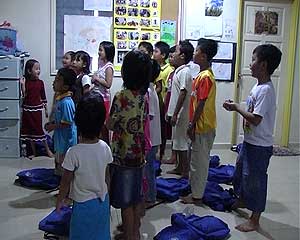 The students, who range in age from four to 12, belong to a community of Chin refugees, who fled conflict and persecution in their home country, Burma.
For the past 11 months, a young teacher has been teaching the children English, Mathematics, Science and their mother tongue.
Malaysia does not differentiate between immigrants and refugees and, more often than not, the authorities treat refugees as illegal immigrants.
Most of the schools are therefore set up by the refugees themselves with minimal funds and teaching materials. The UN High Commissioner for Refugees (UNHCR) provides training for the teachers and books for the students. It also has a uniform syllabus for such schools.
The schools provide the only access to education that the refugee children can obtain as they cannot afford to attend government or private schools. Free schooling is only for Malaysians, and foreigners are obliged to pay a nominal school fee.
Too many of them around
Paul (name changed to protect his identity), a Business Studies graduate from a university in India, fled Burma about a year ago to join his brother in Malaysia.
"I started this school because there are many refugee children in this area, and when their parents leave for work, the younger children are left at home. The older ones have to go out to look for odd jobs," he explained.
 "I hope that by providing them basic education, it will be easier for them to blend into society. It will help build their character and ensure that they contribute to society in the future."
The drop-out rate among children who do not receive any form of education early in their childhood is higher than that among children who have been exposed to basic training. This, he said, is why the school - any school - is important.
The parents of the students contribute to expenses, the bulk of which is eaten up by rental of the premises, purchasing stationery and photocopying teaching materials.
Since refugees are not legally permitted to work in Malaysia, many of the parents have to do odd jobs for a pittance. They pay what they can, when they can towards the running of the school.
The classroom is bare and clean, with a few pictures and paintings on the walls. Several small chairs and low tables are provided for the students, and a small whiteboard for the teacher. The 15 children take turns using a computer.
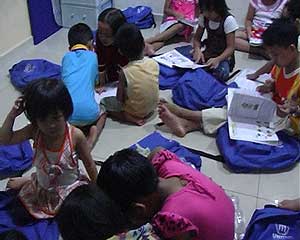
As there are not enough chairs for all of them, the children sit on the floor during activities like singing or when receiving instructions from the teacher.
Satisfaction all round
The lack of financial resources has also restricted the availability of human resources. Paul said he would like the children to learn Bahasa Malaysia, "but we do not have any teachers".
"The students are all at different levels and they are spilt into four groups - pre- school and Primary 1, 2 and 3 respectively," said Paul who does not receive payment for his work, but feels fulfilled by the students' achievements.
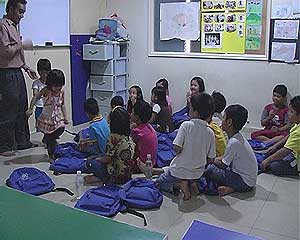 "I teach all of them. Sometimes, it feels like I am teaching 100 students as they all have different requirements and I have to cater to their specific needs."
Due to constraints of space, he said it was challenging to maintain the focus and attention of each group, as some tend to be distracted with what another group is doing.
"Although we do not have most of the materials found in a regular school, we hope that our students will have the same quality of education.
"Some children have had no prior exposure to any kind of education. However, after two to three months of studying, they are able to read and write."
These shy but polite students love coming to school - they even come early, so that they can spend more time in class.
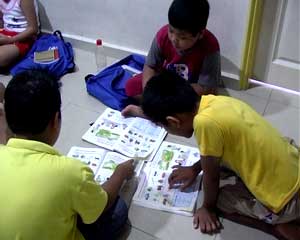 Don (name changed to protect identity), 12, said he even loves tests and that his favourite game is a typing game on the computer.
During Malaysiakini's visit, the children read aloud and, at the end of the session, sang enthusiastically in English .
"Before I came to Malaysia, I felt I could contribute to society by making money," mused Paul.
"But now, I feel that education is very important (for the refugee children) and that this is the best thing for me to do (as I am helping the community). I will continue to teach for as long as I can."


Are you sure you want to delete this comment?
This action cannot be undone.