




Swift 'injustice' at immigration courts
The newly-minted special Immigration Courts are said to be able to dish out instant justice because the right to legal representation seems to have been dispensed with it too.
Wati (name changed to protect identity) is a mother of two - a teenager and a five-year-old.
But the Indonesian national has not seen them for eight years now because she has been working in Malaysia.
Two weeks ago, immigration officers raided the place where she works and was taken into custody.
Her stay now in Malaysia will be extend by another 12 months, but this time as a prisoner.
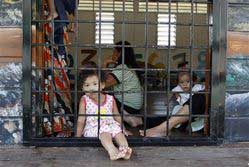 Ah Huey (name changed to protect identity), a Burmese national, was detained because she was working in a restaurant without a work permit.
She has to raise RM5,000 to pay the fine or spend a month in jail, away from her four children.
Her husband is serving out a sentence of a month's imprisonment and will receive one stroke of the whip for the same offence.
Nuri (name changed to protect identity), another Indonesian, has been fined RM10,000, after pleading guilty to a similar charge.
All three cases were heard at the Semenyih Special Immigration Court in Selangor last week, being dealt with swiftly in under 20 minutes.
The court - one of 15 nationwide - processes an average of 200-300 cases a month.
The charge was read to the accused, each nodding to indicate comprehension. When told to enter a plea, they pleaded guilty and the judge imposed the sentence.
No legal representation
There was no legal representation, and the accused were not asked if they require any.
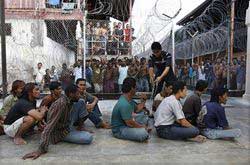
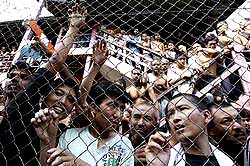
Immediately after sentencing, the accused were escorted out of the courtroom to wait in an enclosed area, enclosed with barbed wire.
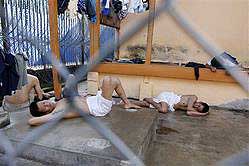
They sat on the cement floor, with little protection from the elements.
 "The process has become very mechanical. Usually there is only a skeleton court structure, which consist of a court clerk, judge and an interpreter," said Tenaganita director Florida Sandanasamy said of the system.
Engaging an interpreter does not guarantee that the accused understands the charge because they may have limited fluency in the chosen language, she said.
"A Bangladeshi may speak ‘Bahasa Malaysia', but only broken ‘Bahasa'. But the charge is read to him in formal ‘Bahasa'. So he might not comprehend the full extent of the charge," she said.
The detainees also do not understand the workings of the legal system, and have difficulty obtaining representation as they have limited access to those outside of the detention centre.
Legal aid
The remote location of the Immigration Courts poses an obstacle to activists and lawyers interested in the welfare of detainees.
"Appearing in court in Lenggeng (Negri Sembilan) takes up a whole day for a lawyer who travels from Kuala Lumpur. So this makes it difficult for lawyers who want to provide pro bono services," said Florida, on problems of representation.
 Such cases were previously tried in the magistrate's courts away from the detention centres, making it easier for legal aid to provide immediate response.
These cases were also generally taken up by chambering students who can mitigate the charges.
This has changed because the Special Immigration Court is on par with the Sessions Court. Therefore only lawyers have locus standi to offer representation.
Widyarka Ryananta, the information, social and culture minister-counsel in the Indonesian embassy, said the Service and Protection department assists Indonesians who face immigration problems in Malaysia.
"We provide legal aid to our citizens upon notification by the Immigration Department," he said when contacted.
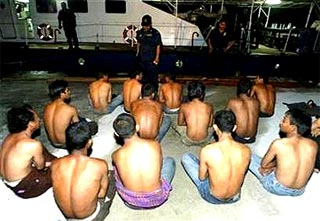 He conceded, however, that it is difficult to monitor all immigration cases as there are about three million Indonesian workers in Malaysia - of whom only 1.2 million hold valid documents.
Currently, the detainees only recourse to legal representation are NGOs like Tenaganita, and legal aid from the Bar Council, as government legal aid does not provide services to migrants. But getting word out once detained is a tricky matter.
"The detainees have a right to one phone call, but this does not happen in many of the cases that are referred to us.
Often they manage to make a five minute call to a friend using a guard's mobile phone, but only if the friend tops up the guard's mobile credit with RM30,"explained Florida.
Posting bail
Even if a detainee understands the charge and decides to not plead guilty, other obstacles lie ahead.
According to sources from the immigration department, detainees are rarely allowed bail.
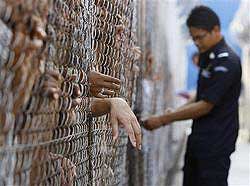 "We do not allow bail because most of the time, the accused will ‘run away'," explained an immigration officer.
This difficulty, said Florida, means that most detainees remain behind bars in detention centres awaiting trials that are more often than not postponed for indefinite periods.
Many detainees thus succumb to the pressures of living in detention, and change their pleas, she said.
‘Rights slaughtered'
Despite the flaws, the implementation of the system was meant to address the problems faced in magistrates courts, where the huge amount of backlog have caused prolonged
litigation.
The immigration officer claimed that more cases have been processed and the system has worked more efficiently compared to the former system.
"But the rights of these (detainees) have been slaughtered in the interest of expediency," Florida disagreed.
The right to seek redress
One way to prevent such ill-treatment of migrant workers, said Florida, is to uphold their right to seek redress.
"In Malaysia we have the Labour Ministry, the Human Resources Ministry and the Home Ministry, and all of these ministries are bound by the Immigration Act, which views migration as a matter of security," she said.
Florida explained that if a migrant worker has ran away from an employer, he or she will get their permits cancelled, making them an undocumented migrant.
"But they may have ran away due to abuse or because they were not paid their wages. And the only way they are allowed to stay is if they press charges against their employers, and have a court case pending," she said.
In such cases, the migrant can apply for a special visa from the immigration which allows them to stay in the country for up to thirty days.
 This visa can only be renewed three times, and it costs RM100 each time. The visa does not include a work permit.
"RM100 is a lot of money for someone who has had his wages withheld, for example. And such trials take more than three months to conclude. So if the migrant wants to have their case tried, they run the risk of being an undocumented worker," she said.
But this is too big a risk for many who choose to return home and their cases cannot move forward.
The right to redress, Florida notes, should also be extended to undocumented migrant workers who have a right to remuneration.
"When these workers are detained in a raid, and are eventually deported, their unearned wages remain unpaid," she said.
RELA not the answer
Further, she added, the issue of undocumented migrant workers is one that should not just be judged at face value. Instead, the government should undertake a critical study to understand why these workers are undocumented.
"We are actually encouraging more migrant workers to come into Malaysia by not looking into issues of labour trafficking. Many of these undocumented workers were duped by agents to whom they have paid a lot of money to arrange for work permits and such," she said.
This is a view that is shared by the immigration officer, who claims that they usually do not charge the victims but instead deport them to their countries.
 The solution, therefore, is not to increase enforcement through RELA, which has in fact made matters worse by exposing undocumented migrants to further abuse.
"The government should stop denying the rights of migrant workers and develop transparent policies regarding this matter," she said.
This first step, she feels, is a critical round table discussion, involving civil society, to understand the mitigating factors and seriously address the problem of undocumented migrant workers.
But this requires recognition that a problem indeed exists.
When asked about the need for improvements on the current system, the immigration officer said, "I think the system has been effective and so far we have not gotten any complaints".


Are you sure you want to delete this comment?
This action cannot be undone.