




Brunei cashes in on Sabah, S'wak traffic
Brunei thinks it is about time that it got something in return for the increasing flow of people and goods in the so-called ‘golden heart of Borneo’ where the sultanate meets the Sabah west coast and northern Sarawak.
There has been a spike of traffic on the Pan Borneo Highway between Sabah and Sarawak which cuts across parts of Brunei.
Brunei thinks it is about time that it got something in return for the increasing flow of people and goods in the so-called ‘golden heart of Borneo’ where the sultanate meets the Sabah west coast and northern Sarawak.
There has been a spike of traffic on the Pan Borneo Highway between Sabah and Sarawak which cuts across parts of Brunei.
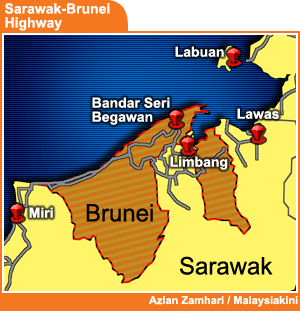 From July 1 this year, Brunei Customs would allow only trucks carrying container cargoes to pass through the border.
Also, the trucks must have been sealed by Brunei Customs. This allows the imposition of transit service charges as well on goods passing through the sultanate but for the moment covering controlled items only.
The items include cooking oil, rice, eggs and newspapers, all daily essentials, among others. Traders feel this is the beginning of a real squeeze on them.
“The July 1 ruling means additional costs for association members. Also, we have to either convert our present open trucks or purchase new closed container cargo trucks,” decried Miri Lorry Owners Association (MLOA) vice-chairman Kong Min Seng.
“We have no intention to violate our neighbour’s laws. All we want to do is just continue our business of supplying enough goods to Limbang.”
The transit services charges were in fact due to take effect earlier on April 1 – not an April Fool’s Day joke as it was first thought - but full implementation was hampered by the use of open cargo trucks.
The MLOA estimates that lorry owners have to fork out nearly RM500 per lorry load of controlled items which have to contend with four international border checkpoints during their passage from Malaysian territory to Malaysian territory through Brunei.
There’s a transit service charge of RM60 for controlled goods carried in private vehicles, even those for personal use, and RM242 if carried in commercial vehicles.
The association warns that its members had no choice but to pass on the extra charges incurred to suppliers or risk losses.
This is expected to spark off a price rise along the chain of distribution. Hence, consumers in Limbang and nearby areas will bear the burden of higher prices compared with other areas in northern Sarawak or the west coast of Sabah.
Negotiations needed with Brunei
The MLOA concedes that Brunei has a right to protect its interests in the matter but hopes that there will be room for a win-win situation which will benefit all parties.
Kong is calling for government-to-government negotiations to settle trade issues along the border. He disclosed that the association recently tried to reason with Brunei Customs on the July 1 ruling but to no avail.
The association wanted to maintain the status quo at least or hope to win lower transit service charges, do away with the need for closed containerised trucks and allow the continued use of the existing system of open trucks.
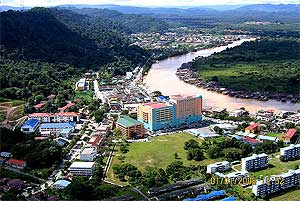 Deputy Transport Minister Abdul Rahim Bakri had a preliminary discussion recently on the transit service charge with Brunei Communications Minister Abu Bakar Apong on the sidelines of the Brunei-Indonesia-Malaysia-Philippines East Asia Growth Area (Bimp-Eaga) meeting in Menado, North Sulawesi, Indonesia.
“This July 1 ruling might derail efforts to enhance trade and undermine the Bimp-Eaga initiative towards transport liberalisation and integration,” Abdul Rahim is quoted as saying in the local media in Brunei.
Limbang MP Hasbi Habibollah, it is said, has enlisted the help of Deputy Minister of Trade and Consumer Affairs Tan Lian Hoe to bring the matter up in the federal cabinet.
Meanwhile, it is understood that Malaysian Customs in Limbang and the Domestic Trade and Consumers Affairs Ministry have been in touch with their Brunei counterparts for details on the July 1 ruling.
The Ministry’s chief in Limbang, Said Nizam, complained that he “had not been notified by Brunei authorities on the implementation of the transit service charge nor were we provided with a list of the goods categorised as controlled items by them”.
“My office has received numerous complaints from local residents in Limbang who frequently cross the border,” said Hasbi. “I hope the Malaysian and Brunei governments will address the issue speedily.”
Batu Danau state assemblyperson, Paulus Palu Gumbang, expects the July 1 ruling to discourage Bruneians from shopping in his constituency.
“It is understandable that some form of control over the movement of goods between Brunei and Malaysia is necessary but it should not be a discouraging factor. The transit service charge, for example, is being imposed without considering whether goods carried by travelers are for personal use or otherwise,” said Gumbang.
“The latest decision by Brunei customs did not augur well for the promotion and development of business and tourism in Limbang.”
All roads go through Brunei
The implication is that Brunei is capitalising on the fact that there are no alternative land links between Miri and Limbang, both in northern Sarawak, except through Brunei territory.
The traffic between Miri and Lawas has not been put off either by having to cross two rivers via ferries and the need to stamp passports eight times and even more if the journey continues to Sabah.
For example, it is normal to queue five hours at the Brunei-Malaysia Immigration checkpoint at Pandaruan in Limbang, three hours at Puni along the border and three hours at Brunei’s Labu checkpoint, the last checkpoint before entering Lawas which is just three hours away from Kota Kinabalu. Lawas is a must stop for Bruneians who visit Kota Kinabalu.
There is a limit to the kind of essential goods that can be brought in by sea and air.
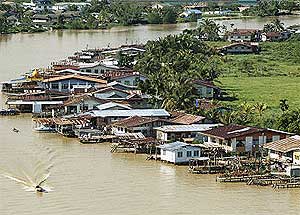 As a result, there have been calls – unsuccessful so far - for an alternative road, albeit much longer, that avoids Brunei territory to link Miri and Limbang.
However, there’s bridge under construction across the Trusan River, about 30 minutes from Lawas. This is expected to ease the traffic flow and do away with the need to queue for the ferry across.
It has been estimated, for example, that an average 1,000 Brunei-registered vehicles cross over into Sarawak daily and a similar number into Sabah.
The biggest pull factor is the Brunei currency which fetches RM2.30 for every unit of the sultanate’s ringgit, according to Ba’Kelalan state assemblyperson Nelson Baling Rining.
Limbang and Lawas, besides Miri, are among the places that Bruneians buy ‘tahai’ (dried fish), adan rice or highland greens. Many also head to Ba’Kelalan in the cool temperate highlands of nearby Sarawak to unwind or head for Kota Kinabalu.


Report this comment
Are you sure you want to delete this comment?
This action cannot be undone.