




230,000 Indonesians 'trafficked' in Sabah
The Jakarta-based International Catholic Migration Commission (ICMC) estimates that the illegal trafficking of Indonesians in Sabah to be as high as 230,000.
The Jakarta-based International Catholic Migration Commission (ICMC) estimates that the illegal trafficking of Indonesians in Sabah to be as high as 230,000.
Abhijit Dasgupta, ICMC’s senior manager said that the figures were derived from a study of 700,000 Indonesian migrant workers in Sabah.
 “We estimate that there at least 100,000 legal and illegal Indonesians working in homes, restaurants, cafes, bars and brothels,” said Dasgupta.
“The others are in the construction, agriculture and plantation industries.”
Dasgupta said this when presenting a paper ‘Combating Trafficking in Persons for Sexual Exploitation’ at a seminar in Samarinda, Kalimantan.
While he could not provide the latest figures, Dasgupta cited a 2003 study by the Ministry of Women’s Empowerment in Jakarta which estimated that about 5,000 Indonesian women were trafficked for prostitution in Sabah.
Dasgupta laid the blame on Sabahans for the huge influx of Indonesians workers as they were unwilling to be employed in dirty, difficult and dangerous work.
He also said the growth of the market economy and a tendency to procure cheaper labour to make maximise profits contributed to the problem.
Dasgupta also pointed out that Malaysia only passed its Anti-Trafficking in Persons Act in 2007.
ICMC figures in Sabah show that 19 per cent of Indonesian migrants came to look for work independently, 16 per cent were accompanied or assisted by their families and friends, while 54 per cent were escorted to and fro in groups by either their recruiters or the recruiters’ representatives.
Indons monitored closely by agents
“The fact that the majority were escorted during their return indicates the degree of control by recruiters or their agents,” said Dasgupta.
“Twenty per cent of the respondents claimed that their passports and their travel documents were falsified in some way by brokers.”
Indonesian migrant workers, according to the ICMC findings, had to fork out between RM833 and RM1,388 as transport fee from their places of origin to Nunukan Island.
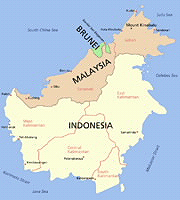 Nunukan is the last stop in east Kalimantan for Indonesian workers bound for Sabah.
The result: Some sell their belongings such as land and animals; others borrow from loan sharks. The luckier ones get help from family, relatives, neighbours and friends.
A good number get their agents to pay their transportation costs, sponsor their stay in Nunukan and the cost of processing their travel documents.
“Those dependent on their agents monetarily were informed that they could repay them through salary deductions. But only few were informed of the amount to be repaid and over how long a period of time,” said Dasgupta.
“It seems that these arrangements are left sufficiently vague to keep the migrant workers under pressure for as long as possible and extract as much as possible from him or her.”
Monitoring system in place
Employers of migrant workers in Sabah have to fork out an annual levy to the state government as well. Although the employees are not liable for the levy, employers generally deducted these from their employees’ salaries every month.
According to the ICMC assessments, migrant workers are not given copies of their employment contracts and this leaves open the possibility that their debts can be increased arbitrarily and unilaterally.
To add insult to injury, most workers had to leave their travel documents with their employers, thus preventing the possibility of their escape from bondage.
Dasgupta said the ICMC’s early findings showed that about five percent were held in "slave like conditions”, three percent were abused verbally, four percent were threatened with bodily harm when they wanted to leave, two percent were forced to carry out “undesirable work” including prostitution and subjecting them to rape and sexual abuse.
“It is clear that there are significant debts among Indonesian migrant workers in Sabah which restrict their mobility and leaves them open to abuse by their employers,” said Dasgupta.
Dasgupta said ICMC has an on-going monitoring system in Nunukan since August last year and is also conducting a survey with help of local partners, the European Union and the US Government.
They cover Indonesian migrant workers passing through Tawau, six key municipalities in Sabah and research on the incomes and savings of Indonesian workers.
“We also get information from official figures issued from time to time by the Sabah and Indonesian governments and their respective agencies,” said Dasgupta.
Assistant secretary to the secretariat of council of anti trafficking in persons at the Home Ministry in PutraJaya, Azrul Izham disclosed that 23 trafficking cases were investigated between Feb 28 last year and April 6 this year.
Of the number, eight have been brought to court and one conviction secured thus far. The 23 cases involve 110 victims under the interim protection order of which eight were children and 41 victims under the protection order that included seven children.
“So we have done better than Australia even though their anti-trafficking in persons laws has been in place much longer,” said Azrul


Are you sure you want to delete this comment?
This action cannot be undone.