




Illegal miners destroy Tawau coral reefs
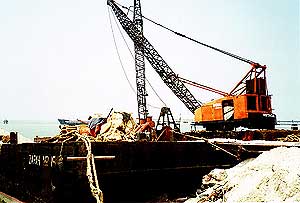
Sabah PKR activists have uncovered a nocturnal operation which has been stealthily mining the coral reefs off Tawau for the last 10 years.
The operation, which is illegal worldwide, has apparently been going on 'undetected' so far right under the noses of the local authorities.
Sabah PKR activists have uncovered a nocturnal operation which has been stealthily mining the coral reefs off Tawau for the last 10 years.
The operation, which is illegal worldwide, has apparently been going on “undetected” so far right under the noses of the local authorities.
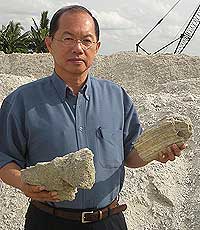 “We estimate that 1.2 million metric tonnes of coral reefs have been destroyed in the last decade by the operators,” said PKR Tawau chief Kong Hong Ming, a lawyer and former state minister.
“The information we have gathered comes from a source who has access to leaks from the operator’s outfit.
“The source did lodge a complaint with the Department of Environment in Tawau, according to him, but eventually he had nothing to show for his efforts.”
Kong adds that 10,000 metric tonnes are being mined every month currently from the coral reefs towards the Semporna Sea Park.
The operation evidently moved to the present site after beginning in the waters immediately off Tawau and then exhausting the site at Kalumpang Sea near Balung.
“If we access the area via Google Earth, it will show a big black hole where the coral reefs used to be,” said Kong.
Huge hammer used to destroy coral reefs
“Only the hard coral or about 30 percent can be used and is processed at a factory in Balung which looks nondescript from the outside but has all the latest equipment.
“They use a huge hammer to destroy the coral reefs and break them down into smaller parts.”
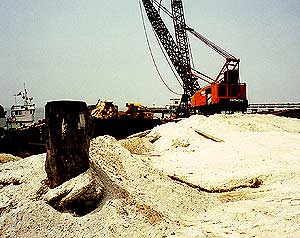 The processed coral from the reefs have a ready market in Peninsular Malaysia for the high-end market which includes bone surgery, dentistry and pharmaceuticals, according to the source.
The individual product list obtained from the operator’s office includes biolime, coral lime, activated lime, calime and calcium carbonate, among others.
Kong disclosed that he went to one of the sites where the mined coral was stored before being taken to the Balung factory.
“One particular site that I visited had 1,000 metric tonnes and we had a photograph taken,” said Kong. “Two days later, they had all been removed.”
The modus operandi pieced together so far suggests that a female individual identified as Chai Nung Yung originally obtained a five-year licence from the Mineral and Geosciences Department Sabah (MGD) on April 19, 1997 to mine sea sand for construction purposes.
The licence fee of RM15,000 and a registration fee of RM50 were paid. There is no evidence that this licence to mine sea sand was renewed upon expiry.
Mining area encompasses five acres
Chai, on July 18, 2007, applied to renew a TOL (temporary occupation licence) which covers the Kalumpang Sea off Tawau.
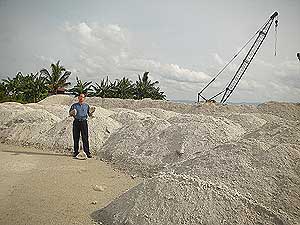 Ostensibly, according to the fact sheets available from Kong’s source, the mining area about nine kilometres from the shore would encompass five acres.
Chai’s operations, according to records with Kong, are actually under Seri Ching Kimia Sdn Bhd and run by her husband, a Peninsular Malaysian, whose name was not disclosed.
“It is clear that no mining of sea sand was ever undertaken. In fact, sea sand is not popular for construction because it takes a lot of work to wash away the salt. So many buildings constructed with sea sand have collapsed in Sabah because the salt was not removed,” said Kong.
“If the operator had ever mined sea sand, there must be evidence of it, like a list of buyers. There is no such evidence. No country in the world allows the mining of sea coral reefs.”
The authorities concerned were not immediately available for comment.
Issue not raised by Sepa
Also, this issue has so far not been raised by the Sabah Environmental Protection Association (Sepa) which has been active in taking up many issues.
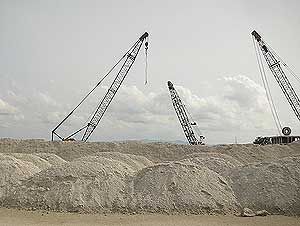 Former Sepa chief SM Muthu confessed that the coral mining off Tawau was news to him. “They are probably mining sea sand,” he said.
“If they are not doing that, then I am really wondering now what is going on in Tawau.”
Helen Brunt, an EcoDiver trainer and Sabah coordinator for the Semporna Islands Project, has been quoted as saying in the local media on Thursday this week that the state needs a regular coral reef monitoring programme.
“Such a programme, as in Peninsular Malaysia, will ensure that the natural wonders in the state are better protected and cared for,” said Brunt.
“Without this monitoring information, it is difficult to make decisions on how to protect the coral reefs. We have been monitoring the reefs in the Tun Sakaran Marine Park for over 10 years and we can see how they have changed.”
Coral reefs are a valuable ecological and economic resource in Malaysia, worth according to one estimate, some US$635 million (RM2.2 billion) per year, mainly from tourism and fisheries revenues.
The entire coral mining area is part of the Coral Triangle which groups together Malaysia, the Philippines, Indonesia, Papua New Guinea, Timor Leste and the Solomon Islands.
The six nations have an on-going programme called the Coral Triangle Initiative on Coral Reefs, Fisheries and Food Security (CTI).
Islands have minimal or no government presence
Seventy-five per cent of Malaysia’s reefs are found in the waters off Sabah.
The Coral Triangle has been labelled by the Worldwide Fund for Nature (WWF) as the ocean’s answer to the Amazon rainforest because of its biodiversity.
 The WWF Coral Triangle Initiative Network has warned that the collapse of the reefs that make up the Triangle would send food production in the region plummeting by 80 percent and imperil the livelihoods of over 100 million people.
A recent Universiti Malaysia Sabah (UMS) sea expedition discovered minimal or no government presence, security gaps and disturbing signs of neglect in the numerous islands dotting Sabah waters.
Of particular concern are the waters off Pulau Tambisan near Pulau Tawi-Tawi, Pulau Silingan and Bakungan Kecil near Sandakan and Pulau Cagayan in uncharted waters and Taganak.
Another security gap was Pulau Banggi near Kudat and not far from Palawan in the Philippines. In Tawau waters, Pulau Sebatik was noted as a weak spot.
Most of these islands are hotspots for smuggling activities, robberies at sea in the past, fish bombing and a backdoor route for the influx of illegal immigrants who slip in and out of Sabah.
They are also along the legitimate barter trade route and the ferries which criss-cross the waters between Sabah, Zamboanga in the southern Philippines and Nunukan in Indonesia.
Related report


Are you sure you want to delete this comment?
This action cannot be undone.