




The Labour pain of transition
The disruption of the Bar Council forum on conversion by a few hundred protesters has been the most notable event in recent weeks. It sparked off a monsoon of commentaries and reactions in the mainstream and alternative media, proving yet once again that religion is still very much a core issue that tugs and plucks at the national heart-strings of Malaysia.
To be sure, the Muslim - or any other group of protesters - had every right to demonstrate their displeasure with the event organisers, irrespective of whether they had the right or the wrong reasoning for doing so. It is their fundamental human right to free expression. In a mature democracy, one even has the right to be wrong.
But for them to demonstrate to the extent of presenting the threat of a violent conflict compelling the Bar Council to suspend the function, they are guilty of the crime of denying the Bar Council their right to freedom of speech. The protesters have abused their right to demonstrate peacefully.
The disruption of the Bar Council forum on conversion by a few hundred protesters has been the most notable event in recent weeks. It sparked off a monsoon of commentaries and reactions in the mainstream and alternative media, proving yet once again that religion is still very much a core issue that tugs and plucks at the national heart-strings of Malaysia.
To be sure, the Muslim - or any other group of protesters - had every right to demonstrate their displeasure with the event organisers, irrespective of whether they had the right or the wrong reasoning for doing so. It is their fundamental human right to free expression. In a mature democracy, one even has the right to be wrong.
 But for them to demonstrate to the extent of presenting the threat of a violent conflict compelling the Bar Council to suspend the function, they are guilty of the crime of denying the Bar Council their right to freedom of speech.
The protesters have abused their right to demonstrate peacefully.
After the event, the DPM pointed his oversized accusing finger squarely on the Bar Council. He had expected this to happen, he said, because the discussion of sensitive religious issues would lead to extreme reactions in “certain quarters”. He was merely echoing the warning given by the PM and the Home Minister before the event, proclaiming that s uch a forum would not be a good idea.
Prdictable communal politics
As usual with such a controversy, the proposals to arrest the event organisers with the ISA or charge them with the Sedition Act broke wind in the media. One would be surprised if they do not. This is Malaysia and we know how things work. If nothing else, communal politics in our country is predictable, no matter how irrational it is!
Fortunately, the ladies and gentlemen in the Bar Council are lawyers, conversant with such things as the ISA and the Sedition Ac t. I am quite sure they can use the legal system to defend themselves very competently.
I could write a whole book on why the Bar Council has tackled this issue with competence and legitimacy, and they have done nothing wrong. But they are more than capable of defending themselves.
Besides, unlike the deep freeze before the March 8 political tsunami, many individuals and organisations are now bolder to step forward and do the right thing. Why, even the MCA president has come out to defend the action of the Bar Council. Even Malay/Muslim columnists have expressed their disquiet on how these protesters have projected a negative image of the Malay community as a whole! Things in Malaysia are finall y loosening up.
Perhaps it is timely if we employ the postmodern method of genealogical analysis after the fashion of Foucault to go back over time and seek to understand how the truth of racial narrative was produced and turned into immutable truth.
Prior to 1957, there was a war of political discourses jostling for dominance in anticipation of filling the political vacuum upon the departure of the British colonial government. With the active support of the departin g colonial masters, the ethnic nationalist narrative emerged as the dominant account of nation-building. Many of its premises and assumptions of a so-called social contract were then written into the federal constitution. A national myth was born.
 Then the May 13 incident threatened to jeopardise and undermine the legitimacy of the mythical social contract and its formula of power sharing among the ethnic communities of the country.
Time was right after 1969 for a rewo
rking of the story of Malay dominance in national politics.
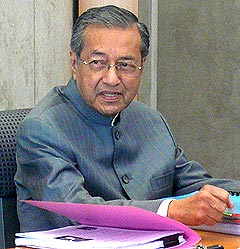
The then Umno dissident, Dr Mahathir Bin Mohamad, answered the call of Umno’s destiny. His book The Malay Dilemma , though banned upon its publication soon after the tragic event of 1969, has since become the most influential theoretical expression of Malay nationalism propagated by successive generations of Umno administration.
Character of Malayness
There, the legitimacy of Malay dominance in national politics based in indigenousness of the Malays was reinforced and reaffirmed many times over. What concerns us here though is a quasi-sociological description of an essentialist character of Malayness to explain how the May 13 came about, with silent pointers on political behaviour in the future to ensure the May 13 would never happen again.
(I am relying on memory here. I read the book 30 years ago, and do not have a copy at hand for reference. I apologise if any mistake in interpretation is made. But the main thrust of the argument has been branded in my brain.)
According to Dr M’s account, the Malays are the sons of the soil, a very communal people who are courteous to a fault, and are willing to bend over backwards to accommodate the demand of migrant races for the purpose of harmonious co-existence.
But the Malays are also very se nsitive people. When they are offended, they tend to keep their hurt inside. This sort of social and political transgression built up over a long time will push the Malays beyond a point of tolerance. Then, they will go amok. That is why May 13 happened.
Since 1969, this idea of ‘certain quarters” within the Malay community running amok if their sensitivities are ignored has always dominated the psyche of non-Malay voters in s ubsequent general elections until March 8, 200 8.
 In case they forget, there would always be those over-zealous Mal
ay individuals in Umno or Malay NGOs who would utter very fundamentalist, right-wing, and almost racist statements to remind others of the possibility of Malays in “certain quarters” running amok.
It happened in 1987 leading to the mass arrest of
Operation Lalang
.
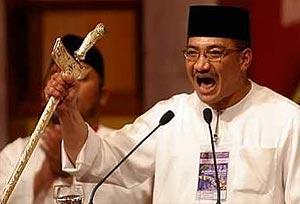
It happened again when the president Umno Youth wielded a
keris
during their general assembly.
This Malay nationalist grand narrative also lends legitimacy to the continued existence of the ISA and the Seditious Act. Certain “sensitive” political issues should never be questioned in public. By corollary and by extension, they should never even be discussed in the public sphere. The offenders d o so at their own peril.
This then is the historical backdrop in the public discourse on the Bar Council conversion forum.
Unlike Dr Mahathir in the early 70s, we have the advantage of hindsight. We have witnessed the very dramatic transformation of the Malay community through the past few decades. Rapid modernisation and urbanisation have diversified the Malays, along educational, social, regional, religious, occupational, and class lines. They are no longer the almost homogeneous agrarian ethnic community that Dr M observed in the early 70s.
Old habits die hard
Most Malays I know are still courteous, because showing berbudi bahasa is still very much a Malay traditional virtue, as it ought to be for all races. But I doubt if the Malays nowadays, or any other ethnic group for that matter, are susceptible to the primordial urge to run amok from perceived social inj ustice done to them. It is just not the Malaysian way.
Besides, your urban middle-class educated Malay citizens are just like citizens from other ethnic groups. They are equally ready to express their feelings of displeasure through one peaceful way or another when they are insulted, rather than keeping their hurt in their heart. In the end, Dr M’s characterisation of Malayness does the Malays great injustice, by portraying them as such irrational over-sensitive people so prone to social psychosis.
But there would be no shortage of “certain quarters” within the Malay community who want to make Dr. M’s description of Malayness a self-fulfilling prophecy. They are called agents provocateur . While the myth of racial politics has been debunked to a certain extent in the March 8 general election, and others are looking for other forms of narrating politics in the new political landscape, these dinosaurs are still mired in the quagmire of the discourse invented half a century ago. Old habits do die hard.
For any democracy to mature and blossom, we need to nurture a confident enlightened citizenry who can discuss any subject under the sun, with full mutual respect for one another, and with the common objective of working towards a consensus for a better future for all.
The greatest threat and insult to a democratic way of life is the threat of violence. Democracy is all about cool, rational, and sensible talking in the controlled climate of a dialogue or a forum. The parliament is the epitome of such a forum. Violence, veiled or open, is the paragon of nihilism, and ought to be banished from our public discourse altogether and forever.
You may see my name and my face, and judge me as a Chinese speaking. But I am only speaking as a human being, like all of you.


Report this comment
Are you sure you want to delete this comment?
This action cannot be undone.