




Unhappy days are here again!
How many millions of Malaysians fell into a paroxysm of dismay and depression - like I did - on June 4 when the prime minister announced a sharp jump in the prices of petrol and diesel?
The air had been thick with speculations about this latest round of price hike for days. Everybody had been told about the burden of the government in subsidising petrol prices at the pump when the international prices for crude oil are now hovering around US$135.
Everybody has been prepared for some kind of government measure to reduce this massive subsidy, but when it did come, few were ready for the pain and the shock. It is a little like the news of a loved one who has just passed away from a long illness. You are sort of prepared for it, but nobody is ready for the grievous hurt.
How many millions of Malaysians fell into a paroxysm of dismay and depression - like I did - on June 4 when the prime minister announced a sharp jump in the prices of petrol and diesel?
The air had been thick with speculations about this latest round of price hike for days. Everybody had been told about the burden of the government in subsidising petrol prices at the pump when the international prices for crude oil are now hovering around US$135.
Everybody has been prepared for some kind of government measure to reduce this massive subsidy, but when it did come, few were ready for the pain and the shock. It is a little like the news of a loved one who has just passed away from a long illness. You are sort of prepared for it, but nobody is ready for the grievous hurt.
The future for the individual, the country, and the whole Asian region even, suddenly looks very bleak.
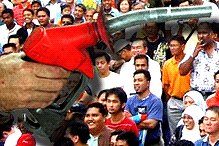 Energy cost is the most fundamental and essential component of production and transportation costs in all aspects of industry and commerce. Such a hefty hike in petrol and diesel prices will certainly set off another chain reaction of hikes in the market prices of daily necessities.
Those with some social concern will immediately think of the people in the lower income group. Many Malaysians are paid RM800 or less a month. How are they going to make ends meet, support a family, and save for their children's education? Will this tsunami in the rising prices of goods drive people to crimes and threaten our already fragile situation in public security?
Most Malaysians in the urban middle-lower income group would probably try to cope by tightening their belt and pinching pennies. Will this set off a round of reduction in domestic demand and dampen growth?
Reality haunts us
We can comfort ourselves with the thought that energy costs in Malaysia is the lowest in the region, and that people in Singapore, Thailand, and India pay much more for their patrol. We can even pat ourselves on the back with the reminder that Malaysia has achieved much socio-economic progress in past decades, while that the rural poor in India are compelled to spend half their daily wage on food alone.
But the reality of crunch living still haunts us. The talk of a minimum wage is just that, talk, and nothing else. How can people living with their nose above the water survive the coming days, especially for the deprived citizens like the disabled, the pensioners, the small-holders, the fishermen, and others who live from hand to mouth?
Economists can debate to no end as to the wisdom of the government's decision to free itself from the bondage of providing subsidy, so that the RM13 billion per annum or so saved may be directed elsewhere for development purposes. We can even question the whole idea of subsidy and price control, and advocate for a true system of monetarism, where market forces should rule the economy instead of government intervention all the time.
But the small men and women on the street are not going to be overtly concerned with macro-economic issues. With such a big hole cut out from the pocket, their anger must seethe and fester quietly in their breast, waiting for the next general election.
From now on, the financially frayed nerves of the people will be even more sensitive to news reports of massive government wastage, failed white elephants, and revelations of corruption in high places. With the help of the internet media, the pressure on the BN to improve efficiency and eradicate corruption will be even more urgent.
This will also bring in fresh parameters in Malay politics.
 After the poor showing of BN and Umno at the recent poll, we hear constant reminder from the royalty to the Malay NGOs the urgent need for Malay unity. It is only to be expected that remnants of Malay ethnic nationalism would not disappear overnight, and in desperation, the forces that have been dominant for half a century should revert to the old addiction to ethnic unity.
But this is a new Malaysia. The vast majority of Malay electorates are working class citizens, many of whom eke out a tough living in urban centres. They suffer from all the political ills that confront the citizens of other ethnic descent. They feel the same pinch as the Chinese, the Indians, the Ibans and the Kadazans when they fork out much more than before just filling up their gas tank at the petrol station. What is the point of Malay unity if your quality of life deteriorates from year to year?
We have not heard from the Pakatan Rakyat what their alternative policy is on this matter of rising fuel prices. They are probably still preoccupied with adjusting themselves in their new role as government in those Pakatan-controlled states. Why, they seem to be struggling with the appointment of councillors for the local government.
By now, as the government-in-waiting, they should have a shadow Cabinet with a shadow Minister of Finance spelling out a comprehensive plan and offering an alternative programme of finance management, detailing how our country is going to face a future of high oil and food prices, among other things. Perhaps they will table their alternative Budget to Parliament by August.
Meanwhile, car owners in the Klang valley must be mulling over a switch towards using public transport to go to work.
An experience with public transport
The public transport system works in strange ways. The buses are always late. You have to wait forever for them. The taxi drivers refuse to take passengers at peak hours. Or they ask that the metre be ignored. The LRT, the commuter train, and the monorail are packed to the brim. All these modes of transportation are not friendly to the disabled and the elderly.
They are also all disconnected.
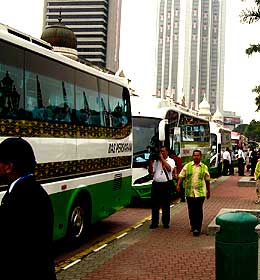 From my neighbourhood in Cheras some 14km from city centre, I need to take two buses (Bus 404 and Bus 407 to the nearest LRT station at Bandar Tasik Selatan. That journey will take well over one hour. Then it's another half and hour or so, depending on the waiting time, before I can board the commuter train to KL Sentral. Then, I have to walk a short distance to the Monorail terminal to get to Bukit Bintang.
The time, the fare, the walking up and down the stairs in the heat, the jostling with young passengers with broad shoulders to get on board, and standing in the crowded train most of the time, make a trip like this for a senior citizen like me most distasteful and stressful.
A senior retired citizen like me can afford avoid KL city centre like the plague. I can just retire gracefully to my hill-top hermitage for days on end. But how about the millions of office and factory workers, and the millions of students, who have to make this expensive painful trip twice a day? Is it any wonder that the minute they can afford it, they would buy a car, and join the rank of the millions of motorists jamming the entire traffic system in the Klang Valley?
It is still a little too early to predict how this sudden leap in fuel prices will affect our nation's economic growth. The higher costs of production will certainly discourage foreign direct investors from pumping in money. They may want to move to Vietnam, but then I hear inflation is 25% per annum in Vietnam!
At the end of the day, you have to derive some degree of solace from the fact that the whole world - except Venezuela where the price of petrol is US$0.05 per litre - is suffering from high energy prices.
The only beneficiaries of this entire saga are the small handful of OPEC countries and the mammoth multi-national oil companies.
Something must be wrong with our world trade disorder.


Are you sure you want to delete this comment?
This action cannot be undone.