




Burma bummer
Whenever I see pictures of General Than Shwe, the current dictator of Burma, I wonder who he imagines he’s kidding with all those fancy medals he wears on his chest. Burma hasn’t fought a foreign foe in living memory, so I guess all the gongs must be some kind of jest. Unless, of course, he’s awarded them to himself for the glorious victories he and his army keep winning in their ceaseless war against the Burmese people.
Whenever I see pictures of General Than Shwe, the current dictator of Burma, I wonder who he imagines he’s kidding with all those fancy
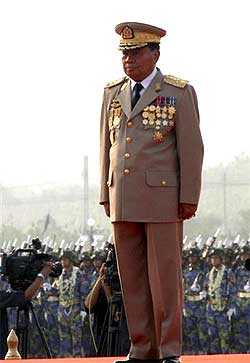 medals he wears on his chest. Burma hasn’t fought a foreign foe in living memory, so I guess all the gongs must be some kind of jest. Unless, of course, he’s awarded them to himself for the glorious victories he and his army keep winning in their ceaseless war against the Burmese people.
Not that they win every battle. After half a century of attempts to crush minority tribes like the Karen, the Burmese army with all its generals and all their medals still can’t control the entire country.
In fact so inept and inefficient is the Burmese military in combat against armed opponents that, according to international press reports, an estimated 1.5 million ethnic minority voters were denied participation in this week’s general election because the regions they inhabit were deemed too dangerous for polling to take place.
 And if the world needed any further proof that, even as dictatorships go, the Generals’ Burma is a total bummer, there was the pitiful spectacle of the election itself. Boycotted by the National League for Democracy (NLD), which won over 80 percent of the seats in the previous general election in 1990 and was then forcibly denied office, this 2010 poll was as phoney as Than Shwe’s campaign decorations.
 With the military’s Union Solidarity and Development Party (USDP) and its proxy the National Unity Party fielding 2,100 of the 3,000 candidates, 25 percent of the total seats allocated to the military, total repression of public assembly and state censorship of the media, gun-toting troops on hand to help get out the vote, and no foreign observers or reporters permitted to witness the proceedings, it was a total sham.
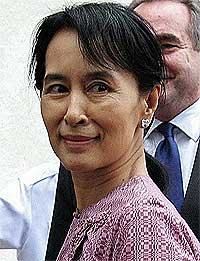
Especially considering that the leader of the NLD in its 1990 landslide electoral victory, Aung San Suu Kyi ( right ), is still under house arrest and, according to Amnesty International, well over 2,000 other critics and opponents of the illegitimate military regime are in jail.
‘Neither free nor fair’
This fraudulent election has been condemned by a good many democratic governments around the world as “neither free nor fair”.
But as US President Barack Obama pointed out in a speech in New Delhi the other day, India, the country that bills itself as the “world’s biggest democracy”, has been strangely silent, no doubt due to its commercial appetite for Burmese natural gas. And of course the world’s biggest one-party dictatorship, China, also needs Burma’s gas and the Middle-East oil it pumps through the new trans-Burma pipeline.
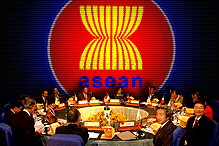 Burma’s partners in Asean don’t appear to be too bothered by the junta’s abuse of its citizens either.
To be sure, as the Asean website proclaims, the “fundamental principles” of Asean include “mutual respect for the independence, sovereignty, equality, territorial integrity and national identity” of its members, “the right of every (member) state to lead its national existence free from external interference, subversion or coercion,” and “non-interference in the internal affairs of one another.”
But Asean Vision 2020 also lists among its aims being “bonded together...in a community of caring societies,” working towards “the empowerment of civil society that gives special attention to the disadvantaged, disabled and marginalised and where social justice and the rule of law reign,” and the governing of member nations “with the consent and greater participation of the people with its focus on the welfare and dignity of the human person and the good of the community.”
Social justice? Rule of law? Government by the conset of the people? Focus on the welfare and dignity of the human person?
 That doesn’t sound much like Asean to me. The government of Laos, from all I hear, is as lousy as Burma’s. All the other members but Singapore are riddled with government-enabled corruption. And all including Singapore put political control, repression or outright autocratic rule way before such humane considerations as the welfare and dignity of the human person, let alone universal human rights.
Admittedly some Asean members are showing signs of improvement. The people of post-Suharto Indonesia enjoy more freedoms these days, as long as you don’t count the downtrodden population of Irian Jaya. The new president of the Philippines is the son of an opposition leader that the Marcos regime murdered, though he’ll have his work cut out cleaning-up the Marcos-style violence and corruption that still plague the Filipino people.
Still going downhill
But other Asean members appear to be still going downhill. Burma for one, despite this sham election. And Malaysia, still sinking steadily in the world press freedom and corruption rankings, and still in the death-grip of its fraudulent Barisan Nasional regime, with its raft of repressive laws and politicised police, judiciary, election commission and other civil institutions.
A great many Malaysians are pinning their hopes for a sorely-needed change of government on the general election due to be held before 2013.
 But pessimists are predicting that, if opposition parties win that polls despite all the state resources stacked against them, then BN will use its police and its sinister paramilitary force, Rela, to foment unrest as a pretext for declaring a state of emergency, thus maintaining the status quo, just like the Burmese generals did two decades ago.
And just as Burma has kept the figurehead of popular resistance to the ruling regime, Aung San Suu Kyi, under house arrest for most of the past 20 years, Malaysia’s BN has already imprisoned reformasi leader Anwar Ibrahim once on a bum sodomy rap, and is currently striving to repeat the performance.
So it seems that, far from protesting against Than Shwe’s and his generals’ outrageous mistreatment of their citizens, Malaysia’s BN regime seems hell-bent on taking a similar path, and could eventually turn Malaysia into as big a bummer as Burma.
DEAN JOHNS, after many years in Asia, currently lives with his Malaysian-born wife and daughter in Sydney, where he mentors creative writing groups. Already published in Kuala Lumpur is a third book of his columns for Malaysiakini, following earlier collections ‘Mad about Malaysia’ and ‘Even Madder about Malaysia’.


Are you sure you want to delete this comment?
This action cannot be undone.